The Archive of Frank Scholten’s Holy Land
The Archive of Frank Scholten’s Holy Land
Or: What is to learn from a Dutch traveler’s photographs from Palestine?
Or: How to deal with a colonial archive?
Or: Why should I look at images while witnessing a genocide?
This research paper is an inquiry into the politics of archives and deals with gazes towards “the other”, using the Frank Scholten collection as a case study. I want to find ways on how to contextualise Scholten’s photographs from Palestine with a critical approach that is sensitive to postcolonial power structures. The research intertwines with more artistic and conversational approaches to the archive as I am not only a writer, but also an artist. This paper was written alongside working on the research-based art project “Interesting Things“. The research paper traces my questions and responses, my learnings and considerations, my doubts and ambitions.
The prologue of the text serves as a personal introduction, stating my point of departure. It speaks about my personal connection to the Frank Scholten collection and touches upon issues that need to be addressed when speaking about photographs from Palestine while witnessing a genocide. The first part of my research paper defines and speaks about the archive; about narratives, collective narration, and the process of iconization, following researcher and artist Ariella Aïsha Azoulay and others who studied the genealogy of the archive. I expand on collective narrations and power relations inherent to the archive. The second part speaks more specifically about the Frank Scholten collection as a Palestinian archive with regards to Orientalism, a Eurocentric viewpoint first defined by Edward Said, and its connected taxonomies.
The third part elaborates on the activation of colonial archives. Ann Stoler speaking about “reading an archive along the grain”, and Leena Crasemann about “unmarked whiteness” are two key concepts that lead to a reflection of representation politics in “visual justice”. A fourth part then speaks about “the other” in the archive and touches upon my artistic work, considering the photographs in the Frank Scholten collection and future audiences. I delve into reflections on my own practice and connections between the research paper and the art project “interesting things”.
I end with a conclusion, expanding on the initial questions: What is to learn from a Dutch traveller’s photographs from Palestine? How to deal with a colonial archive? Why should I look at these images while witnessing a genocide? The Epilogue, responding to the Prologue which served as a point of entrance, reflects on the process, my working methods and insights during the creation of the art project Interesting Things.
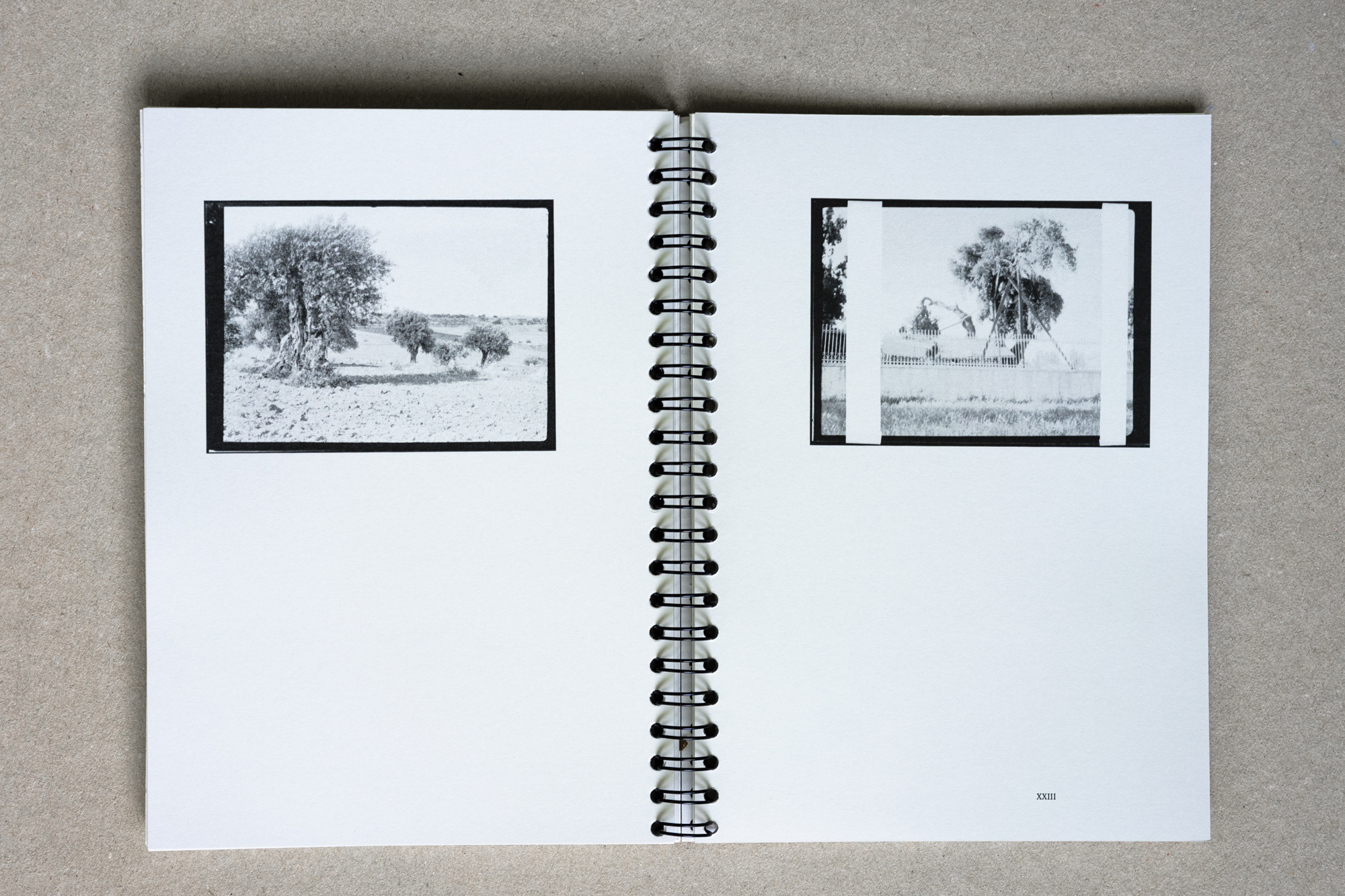
Accompanying, I present in the publication a selection of images from the Frank Scholten collection, titled „some unproblematic photographic illustrations (trees in Palestine 1921-1923)“.
→ connected to the project Interesting Things